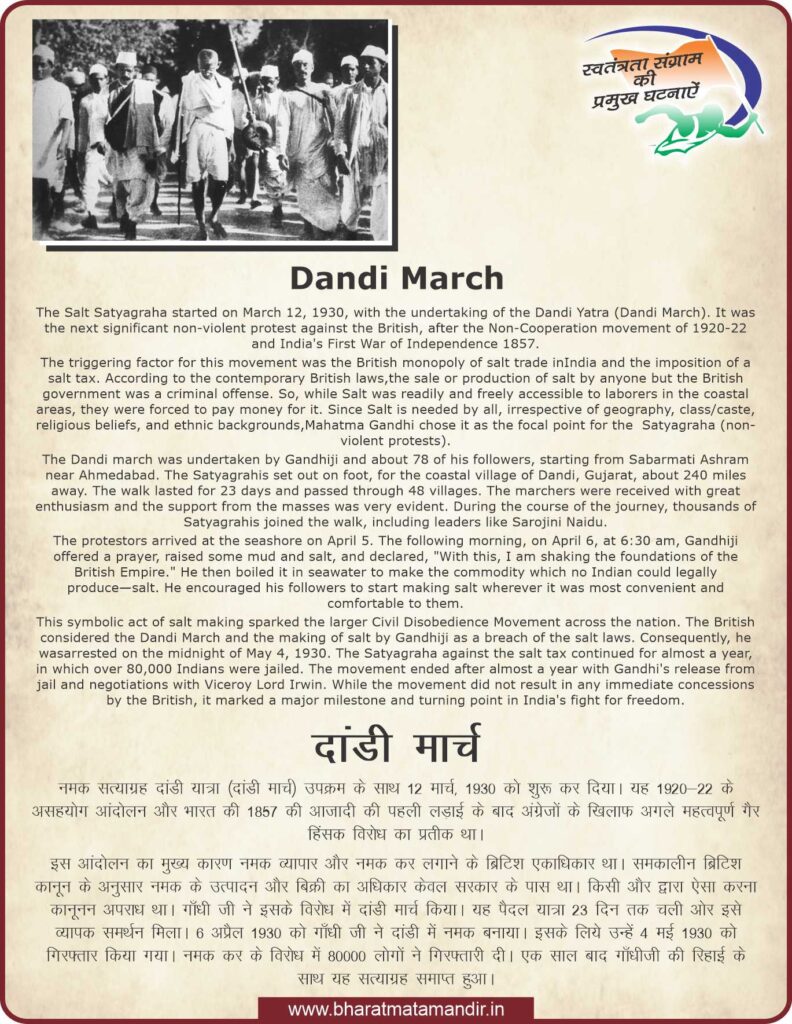
The Dandi March, also known as the Salt March, was one of the most significant movements in India’s freedom struggle. It was launched on 12 March 1930 by Mahatma Gandhi as a powerful act of non-violent resistance against British rule. The march began from Sabarmati Ashram and ended at the coastal village of Dandi in Gujarat.
The main aim of the Dandi March was to protest against the British Salt Law, which prohibited Indians from making or selling salt and imposed a heavy tax on it. Salt was a basic necessity used by every Indian, especially the poor. Gandhi chose salt as a symbol to unite people from all sections of society against colonial injustice.
Mahatma Gandhi, along with 78 selected followers, walked about 240 kilometers over a period of 24 days. As the march progressed, thousands of Indians joined them, turning it into a mass movement. On 6 April 1930, Gandhi reached Dandi and broke the Salt Law by making salt from seawater. This simple act sparked nationwide civil disobedience.
After the Dandi March, people across India began manufacturing salt, boycotting British goods, and refusing to follow unjust laws. The British government responded with arrests and repression, but the movement had already ignited a strong sense of unity and courage among Indians.
The Dandi March marked the beginning of the Civil Disobedience Movement and drew international attention to India’s freedom struggle. It proved that non-violence could be a powerful weapon against oppression. Even today, the Dandi March is remembered as a historic event that strengthened India’s path toward independence.