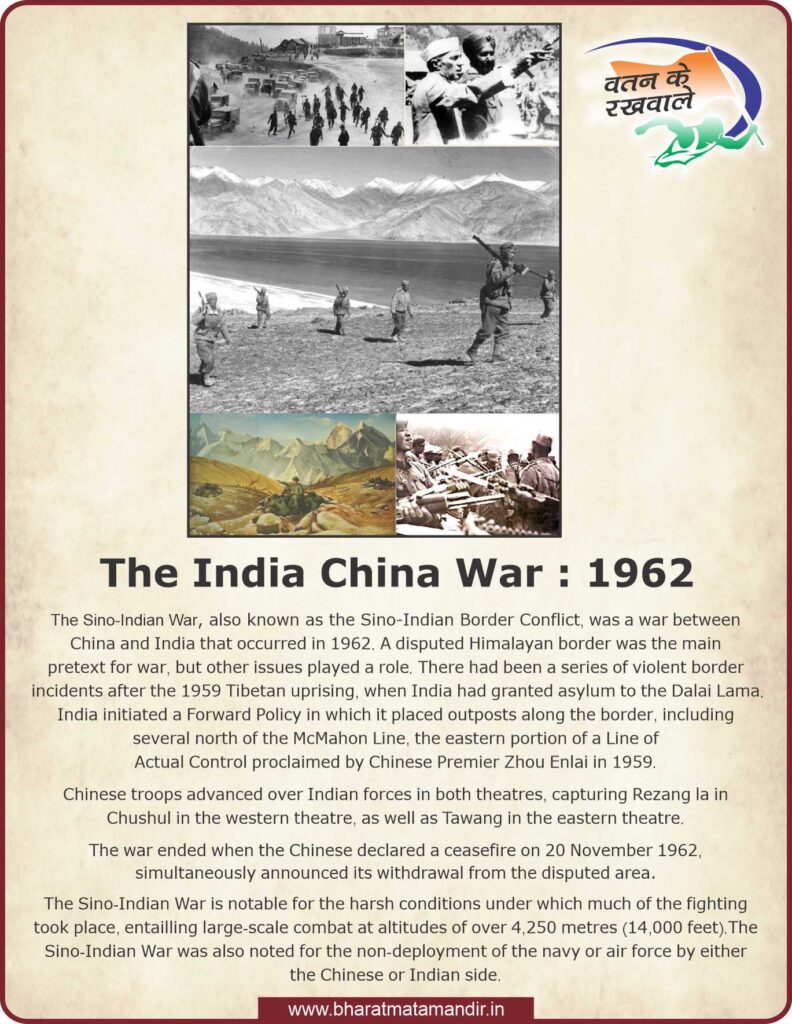
The Indo-China War, also known as the Sino-Indian War of 1962, was a brief but significant military conflict between India and China. It was fought from October to November 1962, mainly over disputed border regions in the Aksai Chin area of Ladakh and the North-East Frontier Agency (NEFA), present-day Arunachal Pradesh.
The roots of the war lay in unresolved border disputes inherited from the colonial period. India recognized the McMahon Line as the official boundary in the eastern sector, while China rejected it. Tensions increased after China built a road through Aksai Chin, which India considered its territory. Diplomatic efforts failed, and border skirmishes gradually escalated into full-scale conflict.
The Chinese People’s Liberation Army launched a sudden and well-planned offensive in both the eastern and western sectors. Indian forces, though brave and determined, were poorly equipped and unprepared for high-altitude warfare. Despite acts of extraordinary heroism—such as at Rezang La—India suffered heavy losses. On 21 November 1962, China declared a unilateral ceasefire and withdrew from some areas, but retained control over Aksai Chin.
The Indo-China War had a deep impact on India’s defense and foreign policy. It exposed weaknesses in military preparedness and led to major reforms, including modernization of the armed forces and increased defense spending. The war also affected India’s relations with China for decades.
The conflict remains an important chapter in Indian history, reminding the nation of the sacrifices of soldiers and the need for vigilance, unity, and strong national defense.