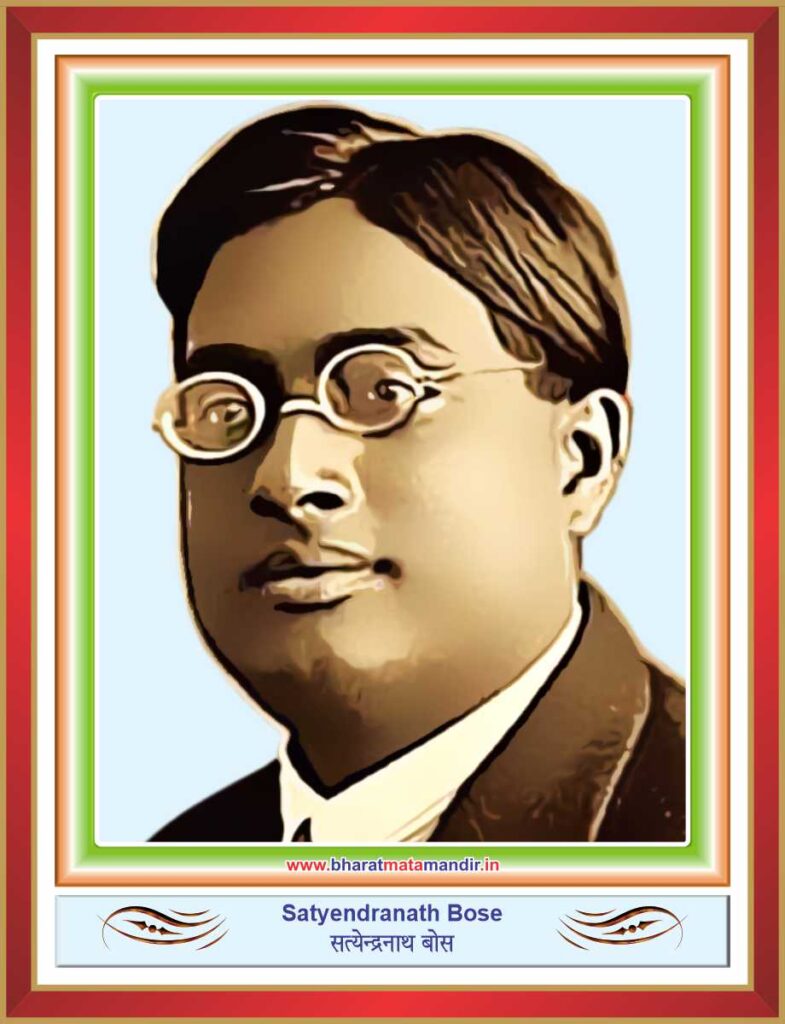
Satyendra Nath Bose was one of India’s greatest scientists and a world-renowned physicist whose work laid the foundation of quantum mechanics. He was born on 1 January 1894 in Kolkata, West Bengal. S. N. Bose is best known for developing Bose–Einstein statistics, a revolutionary contribution to modern physics.
Satyendranath Bose showed exceptional talent in mathematics and science from a young age. He completed his higher education at Presidency College and the University of Calcutta, where he later served as a professor. His deep interest in theoretical physics led him to work on the behavior of particles at the atomic level.
In 1924, Bose sent a research paper on quantum statistics to Albert Einstein. Einstein immediately recognized its importance, translated it into German, and helped publish it. This collaboration led to the formulation of Bose–Einstein statistics and the concept of particles now known as bosons, named in Bose’s honor. These ideas later helped in the discovery of the Bose–Einstein Condensate, one of the most important achievements in modern physics.
Apart from his scientific work, Bose was also a dedicated teacher who inspired generations of students. He served as a professor at the University of Dhaka and later at the University of Calcutta. He believed strongly in the development of scientific education in India.
Satyendranath Bose received many honors, including the Padma Vibhushan in 1954. He passed away on 4 February 1974.
He is remembered as a pioneer of quantum physics, whose work placed India firmly on the global scientific map and continues to influence modern science and technology.