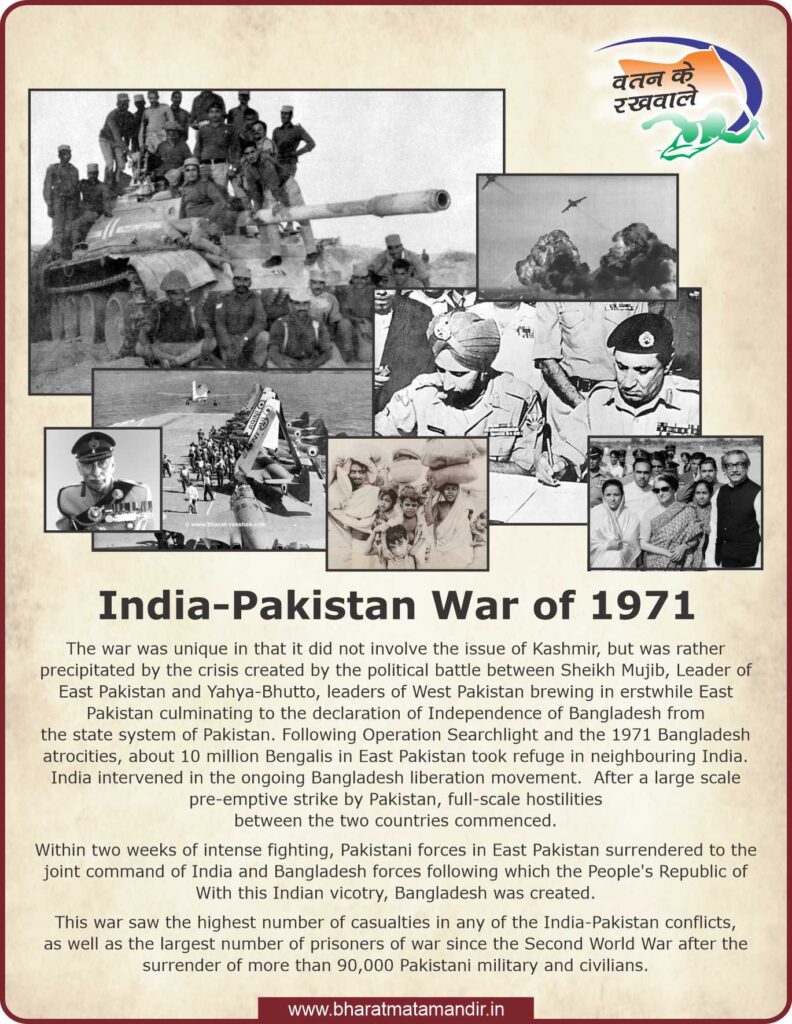
The Indo-Pak War (1971) was one of the most decisive wars in South Asian history, leading to the creation of Bangladesh. The war was fought between India and Pakistan in December 1971, though its roots lay in the political and humanitarian crisis in East Pakistan (now Bangladesh).
In 1971, the people of East Pakistan launched a mass movement for independence after their democratic mandate was ignored by the Pakistani military regime. The brutal crackdown by Pakistani forces caused a massive humanitarian crisis, forcing millions of refugees to flee into India. India provided shelter and support to the refugees and extended assistance to the Mukti Bahini, the Bangladeshi freedom fighters.
The war officially began on 3 December 1971, when Pakistan launched air strikes on Indian airfields. India responded with a coordinated military campaign on both the eastern and western fronts. Under the leadership of Prime Minister Indira Gandhi and the Indian Armed Forces, India achieved rapid and decisive victories, especially in the eastern sector.
On 16 December 1971, Pakistani forces in East Pakistan surrendered in Dhaka. About 93,000 Pakistani soldiers were taken as prisoners of war—the largest surrender since World War II. This historic event led to the birth of Bangladesh as an independent nation.
The Indo-Pak War of 1971 established India as a major regional power and remains a proud moment in Indian history. It is remembered for military excellence, humanitarian responsibility, and the successful support of a people’s struggle for freedom.