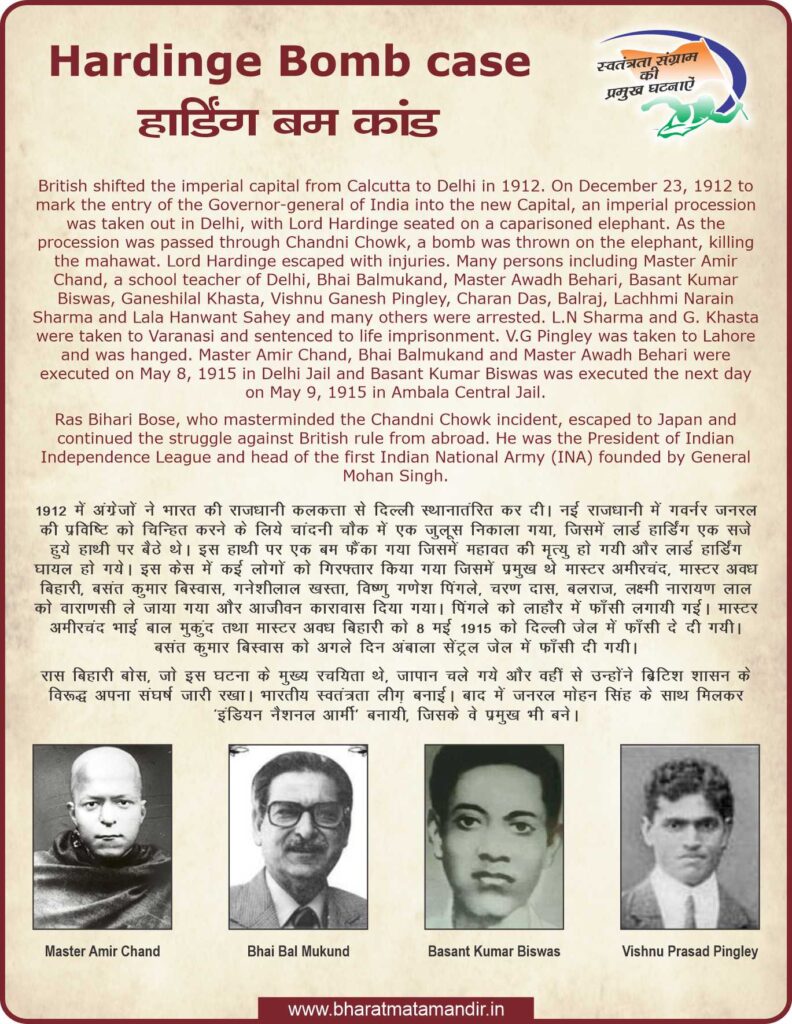
The Hardinge Bomb Case was a significant revolutionary incident in India’s freedom struggle that took place on 23 December 1912 in Delhi. The event symbolized the growing spirit of armed resistance against British rule and marked an important phase in revolutionary nationalism.
On this day, Lord Hardinge, the then Viceroy of India, was leading a grand ceremonial procession in Delhi to celebrate the shifting of the British capital from Calcutta to Delhi. As the procession passed near Chandni Chowk, a bomb was thrown at the howdah of the elephant carrying the Viceroy.
The bomb attack seriously injured Lord Hardinge and killed a British official named Mahawat (the elephant driver). Though the Viceroy survived, the incident shocked the British government and exposed the vulnerability of colonial authority.
The attack was planned by Indian revolutionaries, with Rash Behari Bose playing a key role in organizing the conspiracy. Other revolutionaries like Basanta Kumar Biswas were also involved. Basanta Kumar Biswas was later arrested, tried, and executed for his role in the conspiracy, becoming a martyr of the freedom movement.
The Hardinge Bomb Case had a major impact on the British administration. It led to stricter security laws and intense crackdowns on revolutionary organizations. At the same time, it inspired many young Indians to join the revolutionary movement, believing that bold action was necessary to end foreign rule.
The Hardinge Bomb Case is remembered as a daring act of resistance that demonstrated the courage and sacrifice of Indian revolutionaries. It highlighted the determination of freedom fighters to challenge British power and played an important role in strengthening revolutionary nationalism in India.